An hour from Tallinn: four peninsulas of pine forest and boulder coast, restored Baltic-German manors and Estonia's most-walked bog.
Lahemaa was the Soviet Union's first national park, designated in 1971, and it protects a stretch of coast about 70 km east of Tallinn where four peninsulas push north into the Gulf of Finland. What you get is pine forest on sand, a shoreline littered with erratic boulders the size of vans, half a dozen fishing villages that have been there since medieval times, and a set of Baltic-German manor houses — Palmse, Sagadi, Vihula, Kolga — that range from immaculately restored to romantically collapsing. It is the easiest genuine wilderness day trip from the capital, which also means the car parks fill.
Viru raba is the honest reason most people come. It is a 3.5 km boardwalk loop over a raised bog straight off the Tallinn–Narva road, with a viewing tower halfway, and it is beautiful and completely deserving of its reputation. It is also the most-walked bog in Estonia. Between 11am and 3pm on a July weekend the car park overflows onto the verge and you queue behind pushchairs on a single-file boardwalk. Come at 8am, or at 6pm, or in October when the mire is copper-coloured and there are four cars, and it becomes the thing you remember.
The villages are where Lahemaa stops being a park and starts being a place. Käsmu was the captains' village — nearly every wooden house belonged to a sea captain, there was a navigation school here, and the maritime museum runs on donations and enthusiasm. Altja has a reconstructed net shed row, a swing on the green, and a tavern doing pork, beer and blood sausage for €12-18. Viinistu turned a Soviet fish factory into an art museum. Võsu has the sandy beach and, in August, the only genuine crowd.
By 9pm in summer the light is long and low over the sea at Käsmu and there is almost nobody about; the tavern at Altja stops serving around 9 or 10pm and after that your options are your guesthouse kitchen. In winter half the accommodation closes and the manor cafés run weekend-only hours. Who this suits: families, walkers, cyclists, anyone who wants Estonia's forest without committing to a five-hour drive. Who should skip it: night owls, and anyone who cannot drive.
Where to sleep
Käsmu is the loveliest base — wooden captains' houses turned guesthouses, the sea at the end of every lane, and about 15 rooms in the whole village, so book months ahead for July; €70-120 a night. Võsu has more beds, a beach and a shop, and is the pragmatic family choice at €60-100. Vihula Manor, between Võsu and Sagadi, is the upmarket option with a spa and its own watermill, from around €130-190. Palmse and Sagadi both rent rooms in the manor outbuildings, which is atmospheric and quiet and puts you next to a visitor centre. Loksa is cheap and industrial and not worth the saving. Avoid basing yourself on the Tallinn–Narva highway itself: the motels there are 15-20 km from every village you actually came to see, and the coast roads are slow.
Where to sleep
Hotels in Lahemaa National Park
Rated by real guests, not pulled off a spreadsheet. Rates run the same or better than booking direct, and every booking funds one tonne of carbon removal.
 ★ 4.7
★ 4.7Lahemaa National Park
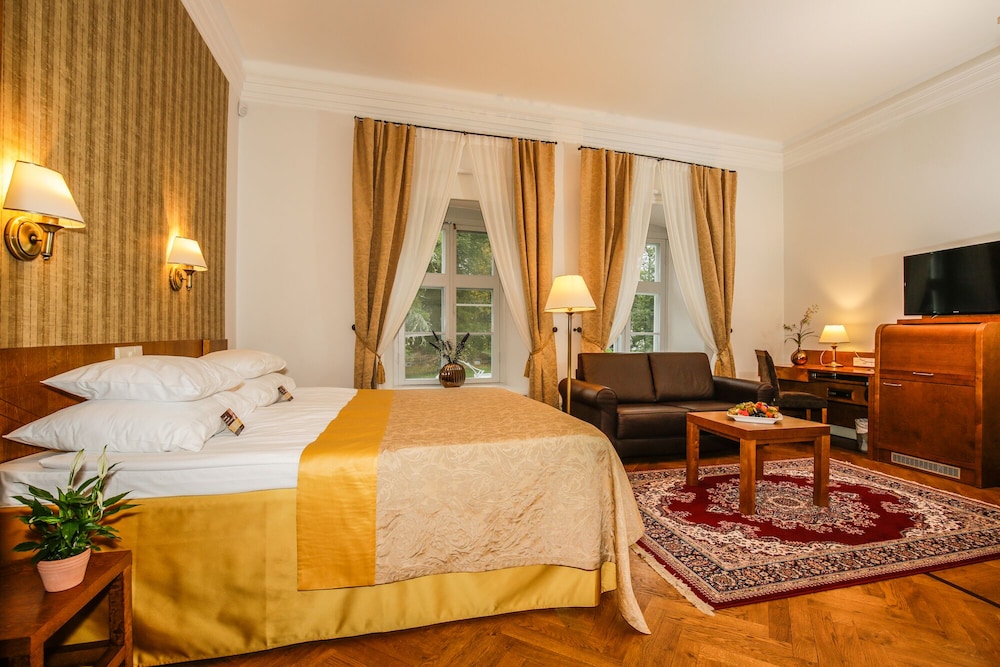
Vihula Manor Country Club & Spa
Guest rating 4.7 · Lahemaa National Park.
$84 / nightReserve
On the ground
Things to do in Lahemaa National Park
- Walk the Viru bog boardwalk at dawnCar park signposted from the Tallinn–Narva road near Loksa junction, free. A 3.5 km loop with a wooden tower over the mire pools. Take it before 9am or after 5pm in summer; midday on weekends is genuinely congested. Roughly 90 minutes at a photographing pace, flat throughout.
- Tour Palmse Manor and its parkPalmse, the restored von der Pahlen estate, sits at the park's main visitor centre. The main house, distillery, greenhouse and swan pond are all open; entry to the manor is around €10 and the park itself is free to wander. The information point here has the best trail maps and current path conditions.
- See the boulders and museum at KäsmuPark at the Käsmu Maritime Museum on the main village lane, then walk north along the shore to the erratic boulder field and the Käsmu peninsula trail. The museum is donation-funded, cluttered with ships' instruments and smuggling history, and one of the most likeable small museums in Estonia.
- Eat at Altja tavern and try the swingAltja kõrts sits at the end of the village road on Altja bay, serving black bread, pork, sauerkraut and beer for about €12-18 a main; closed or reduced hours out of season. Next to it is the village swing on the green and the row of thatched net sheds along the shingle beach.
- Visit Sagadi Manor forest museumSagadi, about 5 km inland from Altja, is a pink 18th-century manor with a forest museum in the stables covering Estonian logging, wildlife and forest ecology — the best rainy-day stop in Lahemaa with children. Combined manor and museum entry is around €10; there is also a café and rooms in the outbuildings.
- Follow the Oandu nature and beaver trailsFrom the Oandu visitor centre between Sagadi and Altja. The forest trail is roughly 4.7 km through old-growth spruce with interpretation boards; a shorter loop leads to active beaver workings on the Altja river. Free, well marked, open all year. Dusk gives the best chance of seeing beaver.
The essentials
Käsmu peninsula shore loop (8 km)
Start at Käsmu Maritime Museum, walk north past the captains' houses and the small harbour, then follow the shore path over shingle and through pine to the erratic boulder field — some blocks stand three metres out of the water. Continue to the tip near Käsmu lake, then return on the inland forest track past the lake edge and back into the village. Roughly three hours, uneven underfoot, no facilities beyond the village.
Getting there & around
A car is the sane way to do Lahemaa: it is 70-90 km from Tallinn on the E20 Tallinn–Narva road, about an hour to the Viru bog turn-off, and the villages sit 10-25 km apart down dead-end peninsula roads with no bus link between them. Without a car, coaches from Tallinn bus station serve Võsu and Käsmu a few times a day, taking about 1 hour 30 minutes for €5-8, and Loksa more often; that gets you a base but not the park. Cycling is excellent — flat, quiet asphalt with long forest stretches, and several guesthouses rent bikes for €15-20 a day. Fuel and a full supermarket are in Võsu, Loksa and Kunda; nowhere in the park is open late.
Good to know
Lahemaa National Park, questions answered
Can I visit Lahemaa as a day trip from Tallinn?
Yes, and thousands do. With a car you can comfortably fit Viru bog, Palmse Manor and either Käsmu or Altja into a day, leaving Tallinn at 8am and back by 7pm. Organised day tours run around €50-70 per person. Two nights in the park is much better if you want the empty early mornings.
Are there really brown bears in Lahemaa?
Estonia has a healthy brown bear population and bears do range through Lahemaa's forests, but sightings are rare and there is no bear hide here. If seeing a bear is the point of your trip, the professionally run photography hides are in the Alutaguse forests further east, booked separately and usually as an overnight.
Is the Viru bog boardwalk suitable for a pushchair?
Mostly yes — it is flat duckboard the whole way, though the planks are narrow, occasionally uneven and very slippery after rain. The viewing tower has steps and is not accessible. A carrier is easier than a buggy if the bog is busy, because passing places on the boardwalk are limited.
What is open in Lahemaa in winter?
Palmse and Sagadi keep reduced winter hours, the trails and boardwalks stay open and are magnificent under snow, and Vihula Manor runs all year. Most village guesthouses and the Altja tavern close or go weekend-only from November to March. Check by phone rather than trusting listings; daylight is also gone by 4pm.
Keep exploring
Nearby areas

965 stays
Tallinn
A complete medieval walled town with a start-up city bolted on: cobbles, bastions, Kalamaja's wooden streets and Telliskivi's bars.
Stays in Tallinn ↗
stays
Rakvere
Medieval castle with a theatrical twist, a giant bronze aurochs, good pools, and the closest proper town base for Lahemaa's eastern forests.
Stays in Rakvere ↗
stays
Narva
Two fortresses staring at each other across a border river, a vast red-brick mill town, and a sandy resort 14 km north.
Stays in Narva ↗Doing good is the business: every booking through Estonia Destinations funds one verified tonne of carbon removal — same room, same price, no markup.
Search stays